Turbo whistle and blow-off valve sound for your EV.
Squeeze the throttle and the turbo spools up and whistles. Lift off and the blow-off valve lets go. WattGrowl synthesizes the boost live on your phone and plays it through your car speakers, with no hardware and no wiring.
 iPhone Coming soon
- Spool and whistle
- Three blow-off sounds
- Supercharger whine
- Boost gauge
How it works
Boost that builds with your right foot.
In a turbocharged car, exhaust gas spins a turbine that pushes compressed air into the engine. The faster it spins, the more boost you get and the higher the whistle climbs. Close the throttle and that air has to go somewhere: the pssh.
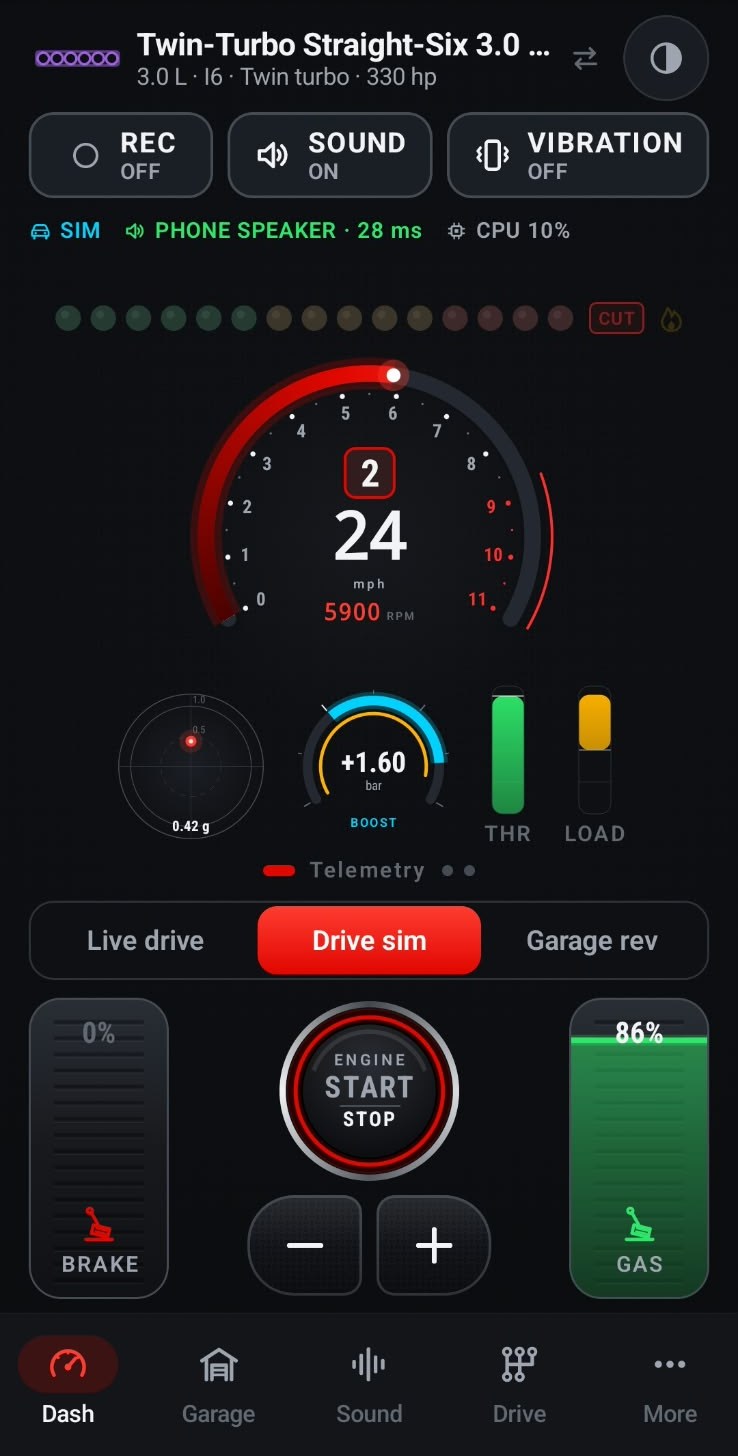
An electric motor has none of this, so WattGrowl rebuilds it in software. In Live Drive it reads your phone's motion sensors and GPS to tell how hard you accelerate, brake or coast; in the free simulator you press an on-screen gas pedal. Push harder and the turbo spools, the whistle rises and the dashboard boost gauge swings up. Lift off and the valve vents.
None of it is a looped recording: the turbo is synthesized as you drive, so the spool follows the revs and the load.
Blow-off valve
Three ways to let the boost go.
Lift off and the boost has to escape, in one of three ways.
Recirculating pssh
The valve routes the released air back into the intake, so the hiss is short and soft and sits under the engine note.
Atmospheric pssh
The air vents to the open, so the release is louder and sharper every time you lift.
No valve: stututu
With no blow-off valve at all, the trapped boost pushes back through the compressor in quick bursts. That is the fluttering "stututu".
Superchargers
Prefer a whine to a whistle?
A supercharger is driven by the engine itself, so it makes boost from low revs and sings higher as the revs rise. WattGrowl gives its supercharged engines that whine. The Supercharged V8 6.2 in the Garage uses a Roots supercharger, makes 650 hp and revs to 6,400 rpm, a very different voice from a turbo straight-six.
Every engine is modeled rather than sampled, so the twin-turbo straight-sixes, the quad-turbo W16 and the anti-lag rally boxer do not sound alike.
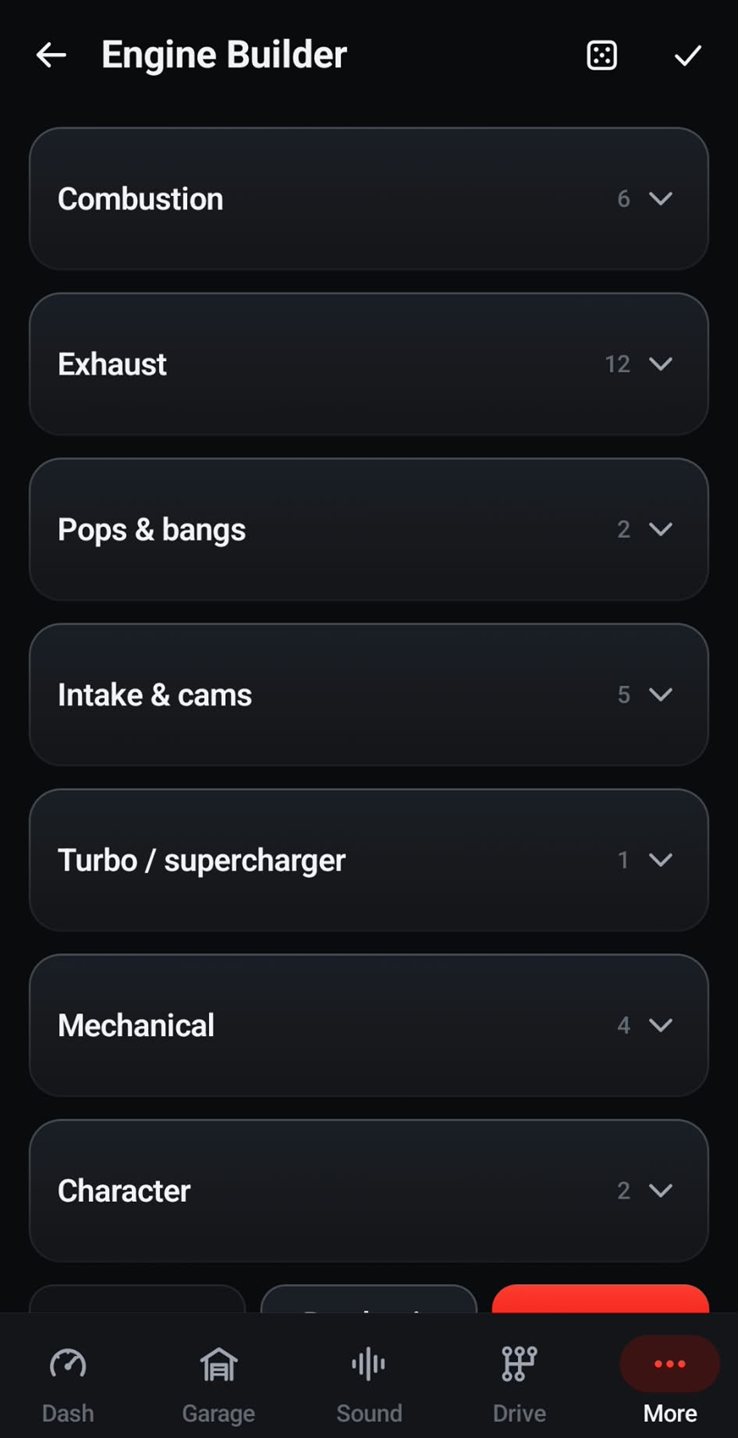
To change one, open it in the Engine Workshop: every synthesis parameter is open, including a Turbo / supercharger section. Or build your own boosted engine from scratch.
Try it
From the garage to the road.
The turbo sound is free to try.
Pick a boosted engine
Choose a turbo or supercharged engine among the 37 in the Garage.
Watch the boost gauge
In Drive sim, hold the on-screen gas pedal, watch the gauge climb, then let go to hear the blow-off. Garage rev lets you blip it while parked.
Set the mix
Move the turbo fader in the Sound Studio, then fine-tune with the equalizer.
- Live Drive (premium) plays it from your real driving, hands-free with the screen off.
- On a stereo or surround car system, the sound stage puts the intake and turbo in front of you and the exhaust behind.
- Set it up before you drive, then keep your eyes on the road.
- It plays inside the car. It is not a pedestrian warning and does not replace your car's AVAS.
FAQ
Questions about turbo and blow-off sound
Can I add a turbo sound to my electric car?
Yes, through your car speakers. WattGrowl synthesizes a turbo engine on your phone and plays it over Bluetooth, USB or a cable. There is nothing to install in the car: no OBD dongle, no wiring, no exterior speaker.
What is the stututu turbo sound?
It is the flutter of a turbo engine with no blow-off valve: when you lift, the trapped boost pushes back through the compressor in quick bursts. WattGrowl offers it alongside a recirculating pssh and an atmospheric pssh.
What is the difference between a recirculating and an atmospheric blow-off valve?
A recirculating valve sends the released air back into the intake, so it sounds short and soft. An atmospheric valve vents it to the open air, so the pssh is louder and sharper.
Does WattGrowl do supercharger whine too?
Yes. The supercharged engines whine as the revs rise, including the Supercharged V8 6.2 with its Roots supercharger, 650 hp and a 6,400 rpm limit.
Is the turbo sound free?
You can hear every turbo and supercharged engine for free in Drive sim and Garage rev. To hear the boost follow your real driving, you need Live Drive (premium): a 3-day free trial on the yearly plan, then $2.99 a year, or $14.99 once for life.
Explore
More from WattGrowl
Hear the boost again.
Try the spool and the pssh for free in the simulator, then take them on the road.
iPhone Coming soon
Follow us on Instagram @engine_sound_app for new engines and the iPhone launch.